Forum Replies Created
-
AuthorPosts
-
North County Jim
ParticipantWere you able to get the sales information? That’s definitely there.
For the property tax data, I tried both address and parcel number with no luck. My guess would be they’re not in the system yet.
BTW, did you notice the information on 1**1 Championship? Closed for $996k in January. Current asking price of $900k.
ParticipantSlowly but surely the zeitgeist is changing.
ParticipantIn fairness, many people are forced into spending their equity, because wages have not kept up with inflation.
Are you saying there are no alternatives for people spending their equity? It’s not their fault?
Is anyone responsible anymore?
ParticipantHere’s the link for prior sales. Go to town.
ParticipantIt made me wonder how the dynamics of the massive home price increases in SoCal (which are still much too high), are affecting the availability of educated 25-40 year olds in the workforce.
High housing prices don’t seem to prevent Boston, New York and San Francisco from having a wealth of younger, educated workers.
The forces you mention (outsourcing, home prices, etc.) should be in play in the long-running urban centers, no?
According to reports I’ve read in the past, southern California gained younger residents while losing middle aged and older residents during the last downturn. Admittedly, this dynamic was the result of the collapse of one dominant industry.
Powayseller has mentioned an exodus of residents from San Diego. Wouldn’t it be safe to assume that a significant fraction of these are long-time residents with large equity stakes cashing in their chips? This group must be skewed older than the general population.
I’m sure there’s a lot more at play here than meets the eye. Thoughts?
ParticipantMichigan also has a more-generous-than-average welfare net. It’s almost like they’ve adopted the servicing of poverty as their primary industry.
I’m sure I’m not alone in wondering how they’re going to fund the welfare state with a shrinking tax base. Throw in an abysmal credit rating and a bloated, unionized work force with generous pension and medical benefits and you’ve got the perfect storm.
Like the man said, it’s a matter of when, not if.
ParticipantDetroit is the economic basket case of America. Besides being overly dependent on an ailing industry, they have a shrinking population (the city has lost half its residents over the past 60 years). The city’s former auditor-general put it this way: “Insolvency is certain. The only question is the timing of the inevitable.”
Here’s a link to an op-ed in the WSJ from a Detroit News columnist that’s worth a read.
Is there a silver lining for Detroit? Yes, it’s the housing stock. As it gets cheaper, it will attract more and more poor people.
Here’s a NY Times Magazine article on housing economics and cities. It contains some discussion of Detroit housing and other rust belt cities that have steadily lost population.
This snippet is priceless:
When cities decline, however, the trends get flipped around. Population diminishes slowly, but housing prices tend to drop markedly.
Glaeser and Gyourko determined that the durable nature of housing itself explains this phenomenon. People can flee, but houses can take a century or more to finally fall to pieces. “These places still exist,” Glaeser says of Detroit and St. Louis, “because the housing is permanent. And if you want to understand why they’re poor, it’s actually also in part because the housing is permanent.” For Glaeser, this is the story not only of these two places but also of Buffalo, Baltimore, Cleveland, Philadelphia and Pittsburgh — the powerhouse cities of America in 1950 that consistently and inexorably lost population over the next 50 years. It is not just that there were poor people and the jobs left and the poor people were stuck there. “Thousands of poor come to Detroit each year and live in places that are cheaper than any other place to live in part because they’ve got durable housing still around,” Glaeser says. The net population of Detroit usually decreases each year, in other words, but the city still attracts plenty of people drawn by its extreme affordability. As Gyourko points out, in the year 2000 the median house price in Philadelphia was $59,700; in Detroit, it was $63,600. Those prices are well below the actual construction costs of the homes. “To build them new, it would cost at least $80,000,” Gyourko says, “so there’s no builder who would build those today. And as long as those houses remain, the people remain.”
ParticipantHaving a hole in the backyard is going to be a problem, not an amenity, for most buyers right now.
Pretty darn funny and a pearl of wisdom to boot!
BTW, a very telling picture of the pool. The weeds growing through the steel tell me he stopped paying the contractor a while ago.
ParticipantAs long as Prop 13 has been dredged up again, you may want to read this.
While I don’t necessarily agree with everything he says, I think he does a good job dispelling the notion that the tax burden in California is insufficient.
ParticipantIf there is a recession caused by the housing industry I doubt that anyone with enough money to afford a house with a lawn in San Diego will be so strapped for cash as to fire their gardener and do their own yard work.
I must beg to differ Beach Rat. With ARM resets, foolish HELOCs used to fund prior consumption and income reduction ahead for many in housing-related employment, we’re most likely looking at a significant number of people in some sort of financial distress.
Should that occur, won’t a lot of people cut expenses to the bone in order to survive the storm? If I were in that situation, the gardener would be one of the first to go.
I’ve seen evidence of this already. My neighbor, who is in construction, recently stopped using outside gardening services. As an aside, he also mentioned that the atmosphere on job sites has gotten noticeably chillier.
While getting my hair cut the other day, the woman cutting my hair remarked about how she’s cut back on expenses as a result of gas prices. These cutbacks include gardening, maids, satellite, etc. She claims that she and her husband have cut nearly $600 in monthly expenses.
Unnecessary expenses are always the first to be cut when times get tough.
ParticipantCM,
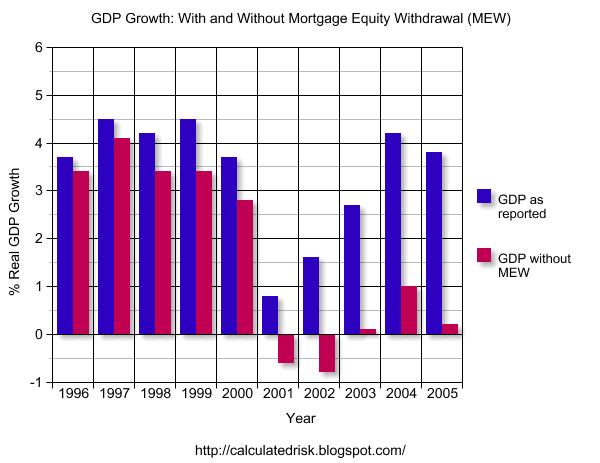
There have been estimates made of the MEW contribution to GDP growth. Here’s a link to a chart from Calculated Risk showing GDP growth with and without MEW.
He used an assumption that 2/3 of MEW flows through to personal consumption.
ParticipantThere have been additional price reductions on both previously discussed REO’s. The Tara Way property has been reduced another $20k to $779k.
The Sycamore Heights place has been reduced $10k to $839,900.
ParticipantSDR,
Any educated guesses about how to split the vacant group in terms of motivated versus testing?
ParticipantBased upon this data, i’d say the 30% figure could actually be too low!
Wow! I think it’s safe to assume we can eliminate these people from the “Testing the Market” category.
-
AuthorPosts