
Forum Replies Created
-
AuthorPosts
-
January 22, 2017 at 3:17 PM in reply to: OT: First real rains in years, time to check your ceilings and walls. #805028
 CoronitaParticipant
Well I am glad many of you like connected devices that depend on things like BLE and wifi even though I won’t use them.
I guess I’ll be mployed a lot longer than I thought.
I think I’ll try to get a schlage lock with BLE and hook up my over the air packet sniffer to see just how secure those things are.
CoronitaParticipant[quote=spdrun]Wouldn’t a burglar just wait till you’re not home, kick down the door, or bust a window and steal a few expensive things before the cops had a chance to get there?
Also, not sure if a cloudfree door lock (say one that communicates with a phone via Bluetooth and requires a private key stored on the phone + code entry) would be less secure than an old-school key.[/quote]
Well first of all, I have an iron security front door. Second, breaking window would be loud and wake up my extremely nosey neighbors. Third I really don’t have valuables to steal at home. The response time from sdpd to my house is pretty quick since I had a few false alarms.
Last, if I was a burglar, I’d hit the other houses that don’t have a burglar alarm.Since my street has a lot of families that are home all the time, that helps too.
CoronitaParticipant[quote=FlyerInHi]Flu, did you look at smart valves?
Here’s a retrofit kind your can integrate with your home automation.
Funny you should mention that. I was talking about this with a coworker last week. But more about sticking a flow meter on it…..
Things are still pretty expensive.. And fundamentally I am cheap…
I think the right solution is getting an actual electronic shutoff value, not using a motor to drive move a shutoff valve. After all, god knows what happens if the valve is stuck and a motor that sits on top of it just tries to force it close.
That said, I’m actually not someone totally into home automation. The way I look at it, the more automation you add, the more suspectible your exposing yourself to vulnerabilities. For things that don’t really matter (like monitoring), that’s fine.
I would never have a remotely controllable door lock into the house, for example.Garage doors are fine since I don’t store anything valuable in a garage, and my cars are always locked even inside the garage. And the door into the house is also always locked and is an old school deadbolt. On top of that, I do have about 24 sensors connected to my burglar alarm. Each room has glass break, motion sensor, and door/window sensors for redundancy (I admit I went overboard), and I have cameras both inside and outside that triggers when anything crosses a perimeter well before anyone is close enough to any of the windows or doors..
CoronitaParticipantI just find it funny that so many of the cabinet position appointees don’t appear to have any experience in what they were appointed into.
I am laughing like at the Dept of education appointee with her comments.
I am laughing at the EPA appointee. And the Dept of energy appointee.
I mean, I understand trying to shake things up with outsiders…But here’s the travesty of it.. to give you an example, a recruiter called me and asked me if I was interested in a management position at a small company. Jokingly I said I wanted to be the VP of product strategy. The recruiter politely said I had no experience with that role…To which I said, well that’s a good thing and that’s why I am a perfect candidate…. because I am an outsider that can think outside the box and bring new ideas to your otherwise stale product line your company has had for the past few years…
I guess if we normalize this as being OK, well I am really not that unqualified.
CoronitaParticipant1. I started the day working from home in the AM.
2. I going to the doctor for checkups.
3. Will be going to my kid school to teach robotics.
4. Will be taking my kid school basketball game, so as a co-coach, we can possibly lose (again)
5. Afterwards, need to take my kid to violin lesson.
6. Then after 6pm finish my work.
7. If I have time I can finish prep my car to paint after the paint burned from a fire.
8. Maybe some of my plumbing parts will have arrived by today.CoronitaParticipant[quote=FlyerInHi]exsdgal, why leave the old components in place. The perfectionist in me doesn’t like this for aesthetic reason. You did the work already, it’s just a pipe and elbow extra.
Flu, I recommend a Kevlar shield. It stays nice and cool.
Why get a threaded valve?Just get the solder kind. So much easier, and you have more room for adjustment. I never replaced a regulator…do they all have threaded connections? I know that you want future serviceability but once you learn how to solder, that is the serviceability. Threads get corroded, the sizes will no longer match, etc… just buy everything new and solder..
Or is there is no leak, just leave good enough alone. I think flood control smart valves are coming to maket.
I’m pretty sure you don’t have home warranty. But for those who do, the insurance company (such as American Home Shield) should repair for the deductible. They may refuse to do the regulator if it’s still working but the valve would be replaced.[/quote]
Hmm I do have a home warranty on my primary. Didn’t even think of that….
CoronitaParticipantexsdgal,
Thanks for encouragement. Looks like a good job.
CoronitaParticipant[quote=harvey]How much would a plumber charge to do this?[/quote]
I think about $300-400, according to one plumber I contacted, not including parts.
The regulator is about $110, the valve about $20, and brass fittings/pipe coupler about $30. So about $160….That’s assuming you source your own parts. Plumbers markup the parts they source.
The cheapest price for a quality Watt regulator I could find was $103, online.
Watts LF25AUB Lead-Free Pressure Regulator 1" Solder Double Union
It’s almost the same as the one home depot is selling for about $130 after taxes
http://www.homedepot.com/p/Watts-1-in-Lead-Free-Brass-FPT-x-FPT-Water-Pressure-Reducing-Valve-1-LF25AUB-Z3/203804614
The difference is just the fittings at the ends… The one I’m buying online has two unions sweat connectors like my current regulator. The home depot version has a FPT threaded union on one side, and fixed FPT threaded on the other.
For future serviceability, I think I want to have one with a union on both sides.2. The valve I plan on getting for $30

It’s threaded on both sides but I’m thinking of adding this union on the side connected to the inflow pipe…..
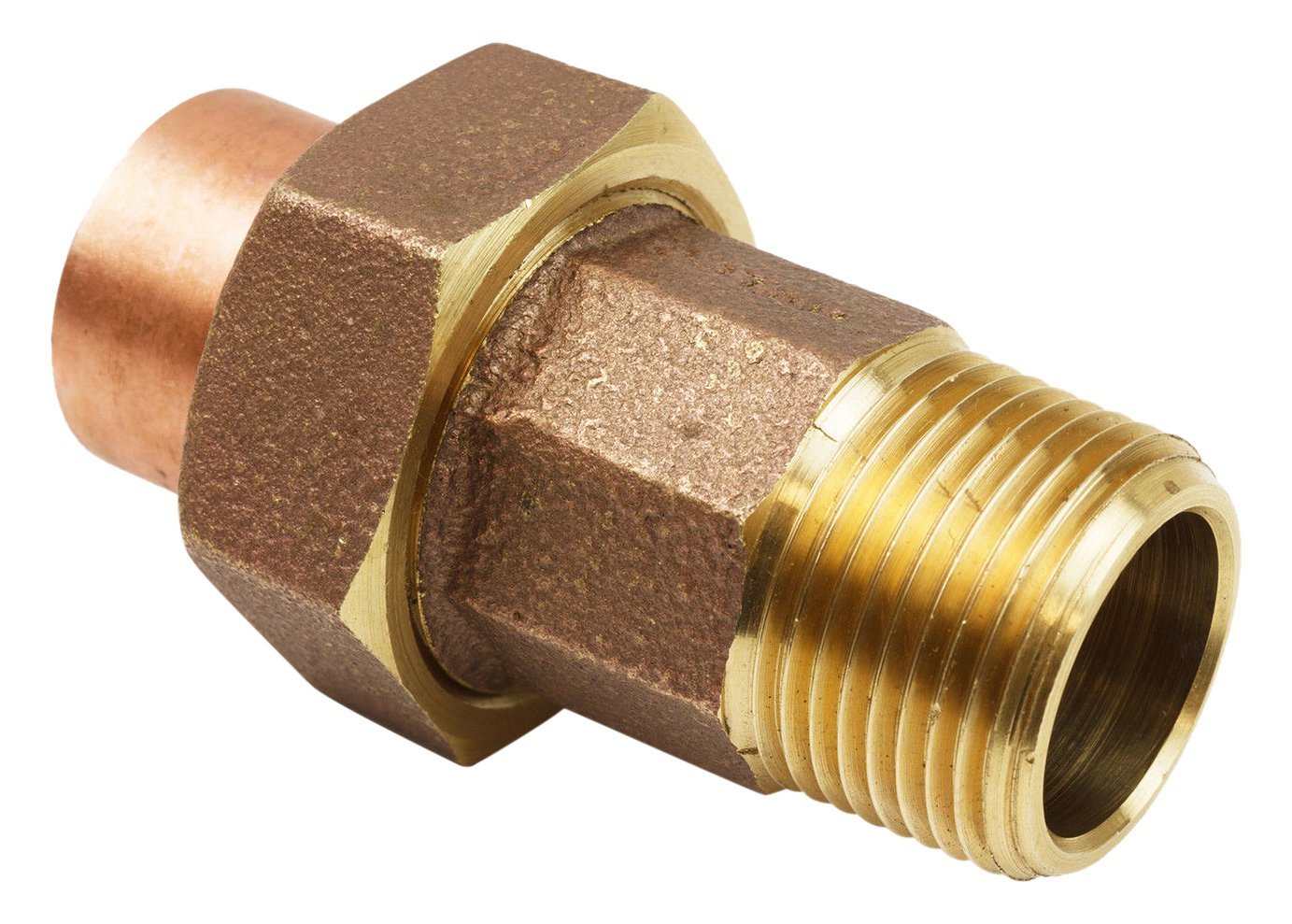
And then on the outflow side, use a sweat to threaded male NPT adapter to connect the valve to the regulator.
I wish they had a 1″ valve with a union at the end, so I wouldn’t need to attach a separate union…
So there will be 3 union. One between the ground pipe and the valve. And two on both sides of the regulator… This should allow me to remove both the valve and the regulator in the future without needing to resolder…
The problem i see is that if I put everything together, I think the length will be longer than currently the distance between the inflow pipe and the one that goes into the wall….So I might need to get creative and run the valve horizontally to the left, the regulator vertical, and a pipe at the top back to the right into the wall, like half a rectangle….
I’m actually excited about doing this now. I get to learn something new…
I’m sick of working on my car after it caught on fire, lol.
CoronitaParticipantSo here’s a side photo of the valve and regulator. I decided not to try to tackle this today, but to think it out more throughly..
[img_assist|nid=26176|title=more plumbing fun|desc=|link=node|align=left|width=500]
As you can see, the two lock nuts on the regulator has enough clearance and (assuming they aren’t completely frozen), should be allow the regulator to be removed.
The concerning part is the bottom elbows. Yes, there appears to be two of them.
Any change of attack? I think the bottom part of the drywall needs to be removed. It’s probably going to get destroyed anyway with any sort of heat to the pipe…
I’m thinking maybe remove both elbows at the bottom and just have a clean pipe running up from the ground to work with…
I also measured the pressure on my pipes. It looks to be around 80-82 PSI…Ouch…I guess it’s been that way for awhile now…
CoronitaParticipant[quote=FlyerInHi][quote=ucodegen]
Contractors (some) love the stuff because it assembles very quickly. Just bid as if you are doing copper and the extra hours saved is just additional $$ in the pocket.[/quote]
maybe… I’m on the HOA board of an early 1980s condo complex and we spend a lot of money on plumbing. the re-routes are all PEX.
I use shark bite fittings when I cannot wait for the whole building to drain in order to solder copper. I’ve use shop vac to suck water out of pipes, but that means I have to solder quickly. I’m slooowww.
You know, when you have a whole building out of water, the residents are all up in arms and want water restored fast.[/quote]
Are we sure PEX is safe for drinking water?
CoronitaParticipant[quote=FlyerInHi][quote=moneymaker]I put a ball valve in many years ago but used shark bite fittings as I did not want to use torches (oxy acetalene) as that was all I had at the time. had no problems but did have to have the water department replace their valve as it was defective at the street, they put a ball valve in as well after freezing the line with liquid nitrogen, talk about working quickly, they had to finish before the line thawed.[/quote]
Shark bites are good. I use them on first floor condos where there are no individual unit shutoff and the whole building needs to be shut off for servicing.
The shark bites pipes are cheaper than copper, but the fitting are expensive.
I have seen new houses with shark bites only with each application plumbed separately in a hub and spoke fashion
I would use Pex if building a new house.
https://www.google.com/amp/www.familyhandyman.com/plumbing/pex-piping-everything-you-need-to-know/amp%5B/quote%5DI don’t know if I would use PEX on potable water. I don’t think there has been any studies done if it is safe for drinking….then again, PVC isn’t exactly good either and lots of houses run PVC.
CoronitaParticipant[quote=no_such_reality]A lot of good observations above.
How much space do you have between the pipes and wall? Mine has about 6 inches, yours looks really cramped in the picture, like maybe an inch. The pressure regulator looks threaded but does look like there is not enough room to turn to thread.
I’d probably go with spdrun’s repack, otherwise redo the whole thing to make more serviceable.
Note: really glad to see all the great advice on the forums again.[/quote]
Yeah, I miss these old forum days. There’s about a 1 inch gap between the wall and the threaded nut on the regulator so I shouldn’t have a clearance problem. The issue is getting it undone. I think getting the regulator off will probably be ok since I can use two crescent wrenches to loosen both nuts.
The valve looks like it’s going to be a PITA. And I was tempted to try to just service the drop gate as ucodegen siggrdted. But then again, I really hate these valves…
For curiosity sake, I wonder if my regulator has already failed so I am going to go buy a gauge to find out.
Thanks everyone for the advice. I really wish we can see more of this sort of thing here on the forums.
So dumb question…..What makes a good MAPP torch versus a crappy one? I am assuming the coupon special at harbor freight would be in the crap category?
CoronitaParticipantAssuming I go the “cut the elbows at the 45degrees mark”, how hard is it to remove the remaining elbow from the pipe? A lot of heat, and some light twists using a vise grip..Or are we talking about a lot of elbow grease?
I’ve never tried to break lose a pipe fitting that has been soldered, so I don’t know exactly know how much force I’m expecting…
Also, I don’t know if I have a saw that can cut through that elbow. Hmmm… Time to add to my tool collection?
If I decide to not cut the elbow, would it be easier if I try to remove the regulator first, and once out of the way, I have an elbow with a little pipe on the top, and a valve and an elbow I can remove separately?…Or am I assuming incorrectly that removing the regulator will be easier than cutting the elbows?
CoronitaParticipantWill a thin piece of aluminum work as a heat shield? I bought a large sheet about 1/32 of an inch thick…i guess it’s the material you can use for roof flashing you can cut with shears….I think I have some leftover from making a underpan for my race Miata, after it caught on fire and melted the plastic underpan…(Never mind what happened there, separate story. )
I am just catching on my long list “things around the house that need attention since a few years ago” debt that I haven’t been working off.
-
AuthorPosts
