
Forum Replies Created
-
AuthorPosts
-
 Rich ToscanoKeymaster
davelj, in the graph of household net worth you linked to:
– inflation was rising during a long-term decline in household wealth as a % of gdp in the late 60s and 70s
– inflation fell pretty consistently during the big runup in household net worth from the late 80s to the early oughtsI’m just noting that a secular decrease in household net worth can happen over an inflationary backdrop, and an increase in net worth over a disinflationary one.
Anyway, to your question: I don’t know what the number is either. But I feel pretty confident that whatever it is, they’re going to go past it. That is the nature of the pressures in our political system (run by hyper-keynesians who only care about getting elected and a voting populace that is over-indebted and unwilling to take short-term economic pain).
Rich ToscanoKeymasterdavelj, in the graph of household net worth you linked to:
– inflation was rising during a long-term decline in household wealth as a % of gdp in the late 60s and 70s
– inflation fell pretty consistently during the big runup in household net worth from the late 80s to the early oughtsI’m just noting that a secular decrease in household net worth can happen over an inflationary backdrop, and an increase in net worth over a disinflationary one.
Anyway, to your question: I don’t know what the number is either. But I feel pretty confident that whatever it is, they’re going to go past it. That is the nature of the pressures in our political system (run by hyper-keynesians who only care about getting elected and a voting populace that is over-indebted and unwilling to take short-term economic pain).
Rich ToscanoKeymasterdavelj, in the graph of household net worth you linked to:
– inflation was rising during a long-term decline in household wealth as a % of gdp in the late 60s and 70s
– inflation fell pretty consistently during the big runup in household net worth from the late 80s to the early oughtsI’m just noting that a secular decrease in household net worth can happen over an inflationary backdrop, and an increase in net worth over a disinflationary one.
Anyway, to your question: I don’t know what the number is either. But I feel pretty confident that whatever it is, they’re going to go past it. That is the nature of the pressures in our political system (run by hyper-keynesians who only care about getting elected and a voting populace that is over-indebted and unwilling to take short-term economic pain).
Rich ToscanoKeymaster[quote=davelj] But taking into account unempolyment + capacity utilization + asset deflation + a low savings rate (which will increase and cut into consumption) + a massive amount of debt that needs to get paid down… probably leads to low inflation for a while. What “a while” is is hard to know…[/quote]
Good list, although I would quibble with the massive amount of debt item… in theory that SHOULD lead to higher saving and lower inflation, but in practice, my strongly held opinion is that it will lead to higher inflation as the political pressure to inflate away the debt is overwhelming.
Anyway, I completely agree that there are factors in place that are holding inflation in check for now (but as you say, how long “now” lasts is a whole different question).
Rich ToscanoKeymaster[quote=davelj] But taking into account unempolyment + capacity utilization + asset deflation + a low savings rate (which will increase and cut into consumption) + a massive amount of debt that needs to get paid down… probably leads to low inflation for a while. What “a while” is is hard to know…[/quote]
Good list, although I would quibble with the massive amount of debt item… in theory that SHOULD lead to higher saving and lower inflation, but in practice, my strongly held opinion is that it will lead to higher inflation as the political pressure to inflate away the debt is overwhelming.
Anyway, I completely agree that there are factors in place that are holding inflation in check for now (but as you say, how long “now” lasts is a whole different question).
Rich ToscanoKeymaster[quote=davelj] But taking into account unempolyment + capacity utilization + asset deflation + a low savings rate (which will increase and cut into consumption) + a massive amount of debt that needs to get paid down… probably leads to low inflation for a while. What “a while” is is hard to know…[/quote]
Good list, although I would quibble with the massive amount of debt item… in theory that SHOULD lead to higher saving and lower inflation, but in practice, my strongly held opinion is that it will lead to higher inflation as the political pressure to inflate away the debt is overwhelming.
Anyway, I completely agree that there are factors in place that are holding inflation in check for now (but as you say, how long “now” lasts is a whole different question).
Rich ToscanoKeymaster[quote=davelj] But taking into account unempolyment + capacity utilization + asset deflation + a low savings rate (which will increase and cut into consumption) + a massive amount of debt that needs to get paid down… probably leads to low inflation for a while. What “a while” is is hard to know…[/quote]
Good list, although I would quibble with the massive amount of debt item… in theory that SHOULD lead to higher saving and lower inflation, but in practice, my strongly held opinion is that it will lead to higher inflation as the political pressure to inflate away the debt is overwhelming.
Anyway, I completely agree that there are factors in place that are holding inflation in check for now (but as you say, how long “now” lasts is a whole different question).
Rich ToscanoKeymaster[quote=davelj] But taking into account unempolyment + capacity utilization + asset deflation + a low savings rate (which will increase and cut into consumption) + a massive amount of debt that needs to get paid down… probably leads to low inflation for a while. What “a while” is is hard to know…[/quote]
Good list, although I would quibble with the massive amount of debt item… in theory that SHOULD lead to higher saving and lower inflation, but in practice, my strongly held opinion is that it will lead to higher inflation as the political pressure to inflate away the debt is overwhelming.
Anyway, I completely agree that there are factors in place that are holding inflation in check for now (but as you say, how long “now” lasts is a whole different question).
Rich ToscanoKeymaster[quote=XBoxBoy]
If I read Hussman’s view correctly, he’s only saying that if the govt wants, it can always create inflation. (Which is pretty much Bernanke’s view as well) So, that begs the question, is it your view that the govt will print enough money to cause inflation?
[/quote]Yes (eventually).
[quote=XBoxBoy]
1) While they are doing all they can to reinflate the various bubbles, they will stop (and put on brakes if necessary) as soon as the bubbles appear to be reinflated. (This is because although they don’t admit it, I bet they are scared of bubbles getting out of hand after the last couple of years)
[/quote]That’s certainly not how they’ve done it in the past. You are probably right that they are more sensitive to bubbles, but they are also more scared of causing another downturn by tightening to early (which BB considers to be the big mistake made by Japan in the 90s and the US in the late 30s).
[quote=XBoxBoy]
2) To cause inflation they have to print enough money to compensate for all the lost money due to defaulting loans, and then some more.
[/quote]Loan defaults do not directly cause money to be “lost”… this has been discussed at length on the site here: http://piggington.com/no_deflationary_spiral_forthcoming
In any case, it’s not like printing money is all that difficult or anything. (As a matter of fact, politically speaking, it’s difficult not to! And this will remain the case unless and until inflation becomes a problem.)
[quote=XBoxBoy]
3) Like most experts, the fed overestimates their abilities and powers. We see that today as they talk of how the recovery is progressing and there won’t be a double dip. Thus they are currently coming off the money printing throttle. If they are wrong, that’s all the more money they will have to print just to fight deflation.
[/quote]…at which time they will press down on the printing throttle again, no?
I don’t want to go down the whole deflation vs inflation rathole as I already said my piece in the article I’ve linked to a couple paragraphs up. My point in responding was that I think there is too much emphasis on employment and capacity utilization as the sole inputs into inflation, to the extent that people simply dismiss inflation risk due to high unemployment. There are many examples of countries (including this one) that experienced inflation during times of high unemployment and slow economic growth.
Rich ToscanoKeymaster[quote=XBoxBoy]
If I read Hussman’s view correctly, he’s only saying that if the govt wants, it can always create inflation. (Which is pretty much Bernanke’s view as well) So, that begs the question, is it your view that the govt will print enough money to cause inflation?
[/quote]Yes (eventually).
[quote=XBoxBoy]
1) While they are doing all they can to reinflate the various bubbles, they will stop (and put on brakes if necessary) as soon as the bubbles appear to be reinflated. (This is because although they don’t admit it, I bet they are scared of bubbles getting out of hand after the last couple of years)
[/quote]That’s certainly not how they’ve done it in the past. You are probably right that they are more sensitive to bubbles, but they are also more scared of causing another downturn by tightening to early (which BB considers to be the big mistake made by Japan in the 90s and the US in the late 30s).
[quote=XBoxBoy]
2) To cause inflation they have to print enough money to compensate for all the lost money due to defaulting loans, and then some more.
[/quote]Loan defaults do not directly cause money to be “lost”… this has been discussed at length on the site here: http://piggington.com/no_deflationary_spiral_forthcoming
In any case, it’s not like printing money is all that difficult or anything. (As a matter of fact, politically speaking, it’s difficult not to! And this will remain the case unless and until inflation becomes a problem.)
[quote=XBoxBoy]
3) Like most experts, the fed overestimates their abilities and powers. We see that today as they talk of how the recovery is progressing and there won’t be a double dip. Thus they are currently coming off the money printing throttle. If they are wrong, that’s all the more money they will have to print just to fight deflation.
[/quote]…at which time they will press down on the printing throttle again, no?
I don’t want to go down the whole deflation vs inflation rathole as I already said my piece in the article I’ve linked to a couple paragraphs up. My point in responding was that I think there is too much emphasis on employment and capacity utilization as the sole inputs into inflation, to the extent that people simply dismiss inflation risk due to high unemployment. There are many examples of countries (including this one) that experienced inflation during times of high unemployment and slow economic growth.
Rich ToscanoKeymaster[quote=XBoxBoy]
If I read Hussman’s view correctly, he’s only saying that if the govt wants, it can always create inflation. (Which is pretty much Bernanke’s view as well) So, that begs the question, is it your view that the govt will print enough money to cause inflation?
[/quote]Yes (eventually).
[quote=XBoxBoy]
1) While they are doing all they can to reinflate the various bubbles, they will stop (and put on brakes if necessary) as soon as the bubbles appear to be reinflated. (This is because although they don’t admit it, I bet they are scared of bubbles getting out of hand after the last couple of years)
[/quote]That’s certainly not how they’ve done it in the past. You are probably right that they are more sensitive to bubbles, but they are also more scared of causing another downturn by tightening to early (which BB considers to be the big mistake made by Japan in the 90s and the US in the late 30s).
[quote=XBoxBoy]
2) To cause inflation they have to print enough money to compensate for all the lost money due to defaulting loans, and then some more.
[/quote]Loan defaults do not directly cause money to be “lost”… this has been discussed at length on the site here: http://piggington.com/no_deflationary_spiral_forthcoming
In any case, it’s not like printing money is all that difficult or anything. (As a matter of fact, politically speaking, it’s difficult not to! And this will remain the case unless and until inflation becomes a problem.)
[quote=XBoxBoy]
3) Like most experts, the fed overestimates their abilities and powers. We see that today as they talk of how the recovery is progressing and there won’t be a double dip. Thus they are currently coming off the money printing throttle. If they are wrong, that’s all the more money they will have to print just to fight deflation.
[/quote]…at which time they will press down on the printing throttle again, no?
I don’t want to go down the whole deflation vs inflation rathole as I already said my piece in the article I’ve linked to a couple paragraphs up. My point in responding was that I think there is too much emphasis on employment and capacity utilization as the sole inputs into inflation, to the extent that people simply dismiss inflation risk due to high unemployment. There are many examples of countries (including this one) that experienced inflation during times of high unemployment and slow economic growth.
Rich ToscanoKeymaster[quote=XBoxBoy]
If I read Hussman’s view correctly, he’s only saying that if the govt wants, it can always create inflation. (Which is pretty much Bernanke’s view as well) So, that begs the question, is it your view that the govt will print enough money to cause inflation?
[/quote]Yes (eventually).
[quote=XBoxBoy]
1) While they are doing all they can to reinflate the various bubbles, they will stop (and put on brakes if necessary) as soon as the bubbles appear to be reinflated. (This is because although they don’t admit it, I bet they are scared of bubbles getting out of hand after the last couple of years)
[/quote]That’s certainly not how they’ve done it in the past. You are probably right that they are more sensitive to bubbles, but they are also more scared of causing another downturn by tightening to early (which BB considers to be the big mistake made by Japan in the 90s and the US in the late 30s).
[quote=XBoxBoy]
2) To cause inflation they have to print enough money to compensate for all the lost money due to defaulting loans, and then some more.
[/quote]Loan defaults do not directly cause money to be “lost”… this has been discussed at length on the site here: http://piggington.com/no_deflationary_spiral_forthcoming
In any case, it’s not like printing money is all that difficult or anything. (As a matter of fact, politically speaking, it’s difficult not to! And this will remain the case unless and until inflation becomes a problem.)
[quote=XBoxBoy]
3) Like most experts, the fed overestimates their abilities and powers. We see that today as they talk of how the recovery is progressing and there won’t be a double dip. Thus they are currently coming off the money printing throttle. If they are wrong, that’s all the more money they will have to print just to fight deflation.
[/quote]…at which time they will press down on the printing throttle again, no?
I don’t want to go down the whole deflation vs inflation rathole as I already said my piece in the article I’ve linked to a couple paragraphs up. My point in responding was that I think there is too much emphasis on employment and capacity utilization as the sole inputs into inflation, to the extent that people simply dismiss inflation risk due to high unemployment. There are many examples of countries (including this one) that experienced inflation during times of high unemployment and slow economic growth.
Rich ToscanoKeymaster[quote=XBoxBoy]
If I read Hussman’s view correctly, he’s only saying that if the govt wants, it can always create inflation. (Which is pretty much Bernanke’s view as well) So, that begs the question, is it your view that the govt will print enough money to cause inflation?
[/quote]Yes (eventually).
[quote=XBoxBoy]
1) While they are doing all they can to reinflate the various bubbles, they will stop (and put on brakes if necessary) as soon as the bubbles appear to be reinflated. (This is because although they don’t admit it, I bet they are scared of bubbles getting out of hand after the last couple of years)
[/quote]That’s certainly not how they’ve done it in the past. You are probably right that they are more sensitive to bubbles, but they are also more scared of causing another downturn by tightening to early (which BB considers to be the big mistake made by Japan in the 90s and the US in the late 30s).
[quote=XBoxBoy]
2) To cause inflation they have to print enough money to compensate for all the lost money due to defaulting loans, and then some more.
[/quote]Loan defaults do not directly cause money to be “lost”… this has been discussed at length on the site here: http://piggington.com/no_deflationary_spiral_forthcoming
In any case, it’s not like printing money is all that difficult or anything. (As a matter of fact, politically speaking, it’s difficult not to! And this will remain the case unless and until inflation becomes a problem.)
[quote=XBoxBoy]
3) Like most experts, the fed overestimates their abilities and powers. We see that today as they talk of how the recovery is progressing and there won’t be a double dip. Thus they are currently coming off the money printing throttle. If they are wrong, that’s all the more money they will have to print just to fight deflation.
[/quote]…at which time they will press down on the printing throttle again, no?
I don’t want to go down the whole deflation vs inflation rathole as I already said my piece in the article I’ve linked to a couple paragraphs up. My point in responding was that I think there is too much emphasis on employment and capacity utilization as the sole inputs into inflation, to the extent that people simply dismiss inflation risk due to high unemployment. There are many examples of countries (including this one) that experienced inflation during times of high unemployment and slow economic growth.
Rich ToscanoKeymasterActually the Hussman article from which I quoted has more good stuff, including some graphs… whole thing is here but this (along with what I quoted above) is the meat:
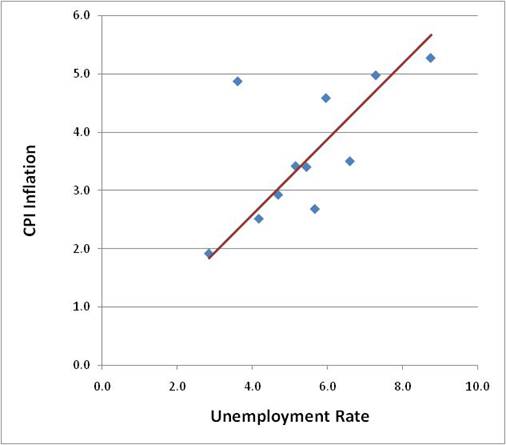
The charts below are based on data since 1947. Monthly unemployment rates were sorted from highest to lowest, divided into equal groups, and the average unemployment rate and year-over-year CPI inflation rate were plotted for each group. What we observe in the data is strikingly opposite to the standard (mis)interpretation of the Phillips Curve. Indeed, higher unemployment is generally associated with higher, not lower general price inflation.
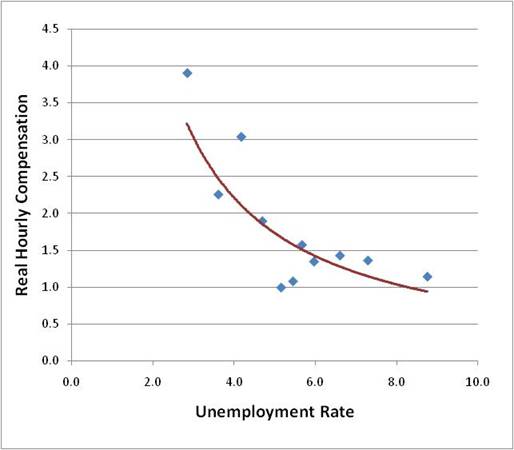
Contrast this with what I would assert is the real Phillips curve, which is simply a statement about labor scarcity. It says, in a very unadorned way, that when labor is scarce (low unemployment), the price of labor tends to rise relative to the price of other things (thus we observe real wage inflation). In contrast, when labor is plentiful (high unemployment), the price of labor tends to stagnate relative to the price of other things (real wages stagnate). Since productivity growth tends to be positive over time, it turns out that real wages actually fall on a productivity-adjusted basis when unemployment is high. From this perspective, it is no surprise that real wages fell by 1.6% in 2009, even as reported productivity grew.
-
AuthorPosts
